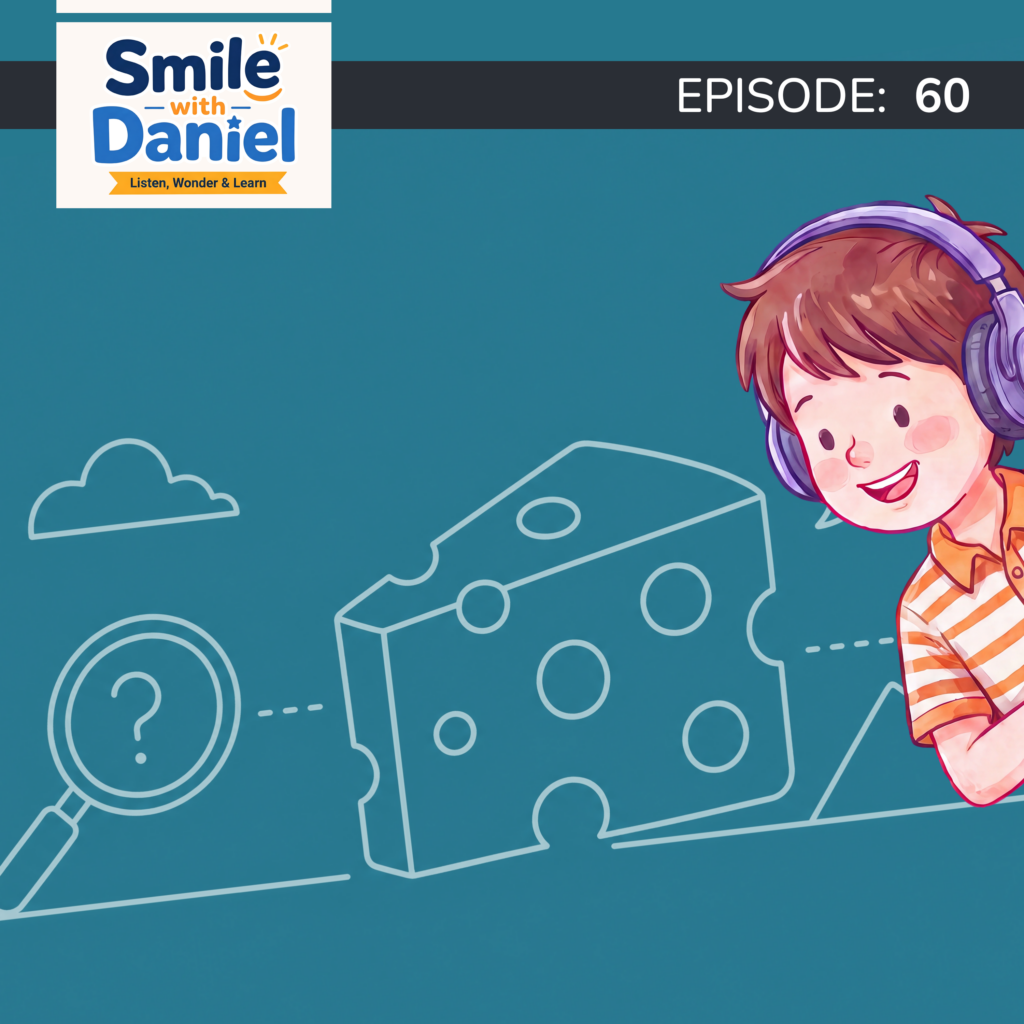
The holes in Swiss cheese are called eyes by cheesemakers, and a cheese with none is called blind. Eyes form during aging when bacteria in the cheese produce carbon dioxide, which accumulates and creates bubbles in the maturing material. For most of the twentieth century, the mystery was why eyes formed where they did. Research published in 2015 by Agroscope in Switzerland linked eye formation to microscopic hay particles from traditional open-bucket milking, which provided the points around which bubbles formed. As modern milking became cleaner, fewer hay particles entered the milk, and Swiss cheese eyes became smaller and fewer.
Daniel asks why Swiss cheese has holes. What follows moves through the eye terminology, the bacterial process, the long-standing mystery of eye formation, and the 2015 discovery that connected cleaner milking to fewer eyes. The episode closes on Daniel’s observation about what the cheese lost when the dairies got cleaner.
Daniel is nine. He asks the questions, refuses to accept easy answers, and picks every episode topic himself.
MomCo-host & Researcher
Mom does the digging - finding the sources, checking the claims, and translating them into something a nine-year-old will actually sit still for.
Things to remember
01
Swiss cheese holes are called eyes. A cheese with no holes at all is called blind.
02
Eyes form when bacteria produce carbon dioxide during aging, creating bubbles in the cheese.
03
Microscopic hay particles from traditional milking seeded eye formation. Cleaner dairies changed that.
04
As modern milking became more hygienic, Swiss cheese eyes became smaller and fewer as a result.
“Modern milking got too clean and the cheese lost its eyes.”
Mom
Full transcript10 min · 757 words
DanielMom, why does Swiss cheese have holes in it? Like, is someone poking them in? Or does something eat through it?
MomDaniel, good guesses, but it's neither. The holes form naturally during cheesemaking. And one of the biggest mysteries about how they form was only confirmed in 2015.
DanielReally? Scientists only confirmed it in 2015?
MomPeople had a theory for over a hundred years, but the full answer turned out to involve something nobody expected.
DanielSo, what was it? Hay! Hay? Like, the stuff horses eat?
MomExactly that. Hay. But let's start at the beginning. Swiss cheese, specifically the kind called Emmental, gets its holes from bacteria inside the cheese.
DanielSo bacteria make the holes.
MomDuring the aging process, certain bacteria eat the lactic acid in the cheese. And as they eat it, they produce carbon dioxide gas. That gas has to go somewhere, so it forms bubbles. And those bubbles become the holes.
DanielSo the holes are, basically, trapped gas bubbles.
MomYes, trapped gas bubbles that expand inside the cheese as it ripens, leaving those round cavities behind. Cheesemakers actually call them eyes. A cheese with no holes is called blind.
DanielBlind cheese? That is the best term I have ever heard.
MomIf you see a perfect Emmental with beautiful round eyes, a master cheesemaker can read them the way a doctor reads an x-ray. The size, the distribution, the shape all tell you something about how the cheese was made.
DanielSo the holes are not just decoration. They are information!
MomExactly. But here is the mystery that bothered scientists for decades. They knew the gas made the holes, but they could not fully explain why the holes formed where they did. The gas needs something to form around. A starting point.
DanielLike what kind of starting point?
MomWell, and this is the part that surprised everyone. Scientists at Agriscope, Switzerland's federal agricultural research institute, started noticing something strange in the 1990s and 2000s.
DanielWhat did they notice?
MomThe holes were disappearing. Modern Swiss cheese was developing fewer holes and smaller ones than cheese made a hundred years ago. And nobody could explain why.
DanielThe holes were getting smaller? How does that even happen to a hole?
MomThe researchers asked exactly that. And one scientist, Walter Bisig, had a hypothesis. He thought the answer might be hay.
DanielHay.
MomIn traditional milking, milk was often collected in open buckets in barns. And in barns, there is a lot of hay. Tiny, microscopic particles of hay dust would float through the air and fall into the milk.
DanielSo the milk had invisible specks of hay floating in it.
MomAnd those specks became the starting points, the nucleation points, around which the CO2 bubbles formed. To test this, Bisig's team added different amounts of hay dust to purified milk and made cheese from it. The more hay particles they added, the more holes appeared.
DanielSo they could control the holes by adjusting the hay.
MomAnd they found something else. More hay particles meant more holes, but smaller ones. Fewer hay particles meant fewer holes, but bigger ones.
DanielSo modern cheese has fewer holes because modern milking is too clean.
MomModern milking machines send the milk straight to a sealed container. No open buckets. No barns. No hay in the air. Far fewer hay particles in the milk. Far fewer places for bubbles to begin forming. Fewer eyes.
DanielSo the holes were a happy accident of old-fashioned farming. And when farming got cleaner, the accident disappeared.
MomFor over a hundred years, people thought they understood Swiss cheese. And it turned out, the real answer was floating invisibly in the milk the whole time.
DanielBecause of hay that nobody was trying to add. That just fell in.
MomThe best scientific discoveries are sometimes like that. Not the thing you were looking for. The thing that was quietly there all along. So Daniel, what is one thing you are taking with you today?
DanielSo let's see. The holes in Swiss cheese are called eyes, formed by CO2 gas bubbles from bacteria eating lactic acid. But you know, the gas needs something to form around. And that something turned out to be microscopic hay particles that fell into open milk buckets in old-fashioned barns.
DanielAlso interesting to remember, when milking got cleaner, far fewer hay particles reached the milk. So the cheese developed fewer eyes.
MomAnd a cheese with no holes is called blind.
DanielI am never going to eat Swiss cheese without thinking about hay again.