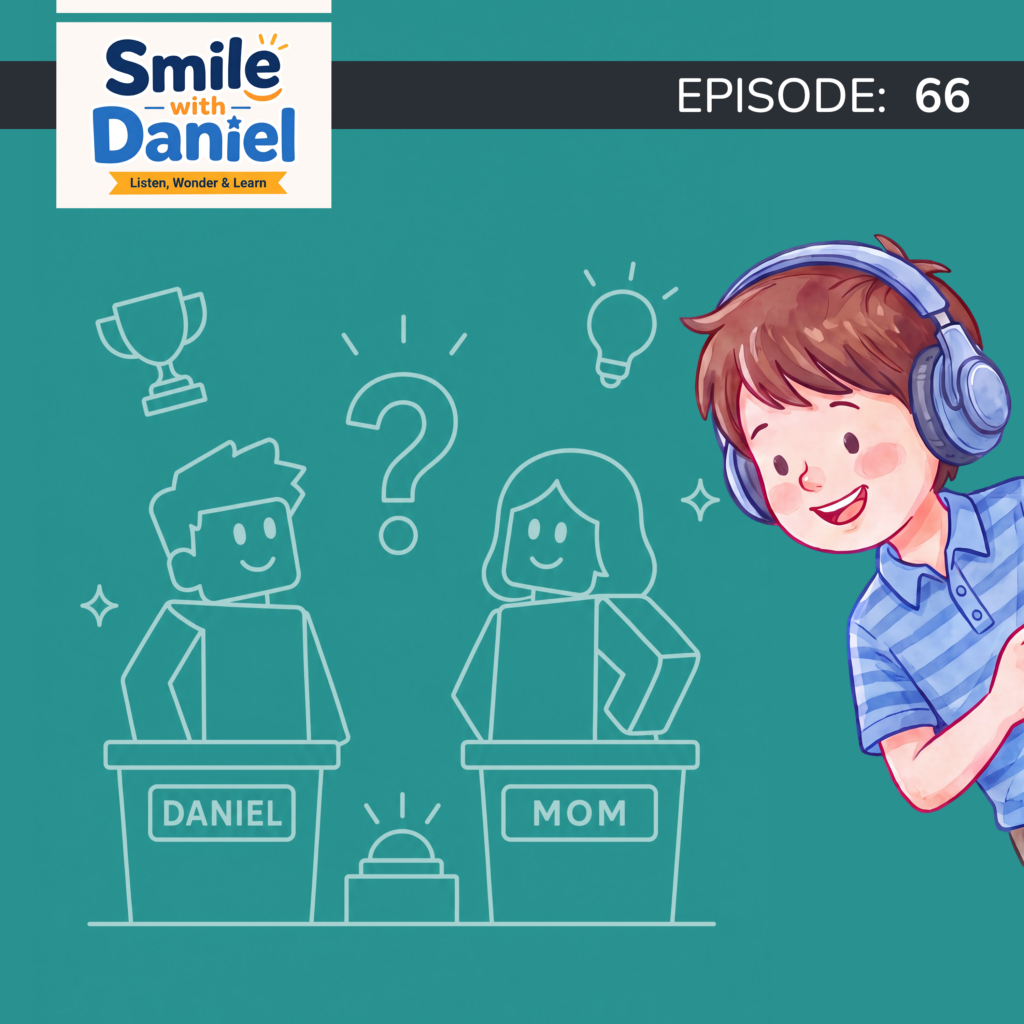
The trivia challenge draws questions from previous Smile with Daniel episodes and general curiosity topics, covering everything from the smell of rain and card shuffling to stars, ocean salt, Swiss cheese, and the human body. The format is designed for families to play along, with a pause after every question so listeners can answer before Daniel or Mom do. The difficulty climbs across fifteen questions, with the final three forming a deliberate championship round. Mom gets one question confidently wrong, Daniel catches her on a bonus question, and neither character dominates.
Daniel opens by challenging Mom with the stated intention of showing no mercy. What follows is warm, competitive, and genuinely surprising in places, particularly when Mom confidently names the wrong answer for the Swiss cheese question. The episode includes a scoreboard callback that bookends the opening joke and closes on Mom’s signature sign-off, which becomes a recognizable ending for special format episodes.
DanielMom, you know what? I want to do something different today.
MomHmm, interesting. But different how, Daniel?
DanielI want to challenge you to a trivia battle. Me against you. 15 questions. No mercy.
MomNo mercy, huh? Daniel, I am a grown adult, you know.
DanielAnd I have been listening to every episode of our podcast. I am ready, Mom. Good luck!
MomBut you know what? I think our listeners should play along too. So, if you are listening right now, shout out your answer before we say it.
DanielLet's go! But I am asking first. Okay, Mom. Question 1. The smell of rain has a name. What is it? Umm, oh. Petrichor? Correct. One point to Mom. But we are not keeping score.
MomThen why did you say one point?
DanielIt is just a habit, you know.
MomMy turn now. Daniel, if you properly shuffle a deck of cards, roughly how many possible arrangements are there? Is it a thousand? A million? Or a number with 68 digits?
DanielThat's an easy one. A number with 68 digits. Correct.
MomAbout eight. Followed by 67 zeros. A number on roughly the same scale as the estimated atoms in the Milky Way.
DanielI knew that one. Because it broke my brain when we did that episode. Okay. General knowledge question. What is the largest organ in the human body?
MomIs it the skin?
DanielCorrect. Most people say the liver or the heart. But skin covers everything.
MomAnd it is constantly renewing itself. Every few weeks, you have mostly new skin. Next question now. Before alarm clocks were widely affordable, what was the job of a knocker-upper?
DanielWalking the streets before dawn and knocking on people's windows to wake them up.
MomExactly. Using long poles, rattles, and in one famous case, a pea shooter.
DanielMary Smith. The pea shooter. Legendary. Okay, let's do the next question now. How many hearts does an octopus have?
MomUm, three?
DanielCorrect. Three hearts. Two pump blood to the gills, and one pumps it to the rest of the body.
MomAnd octopus blood is blue because it uses copper instead of iron to carry oxygen.
DanielI did not know that part.
MomNow you do. This one is about our Ebola episode. Ebola is deadly, but compared to something like measles, is it easier or harder to catch?
DanielHarder. Because it only spreads through direct contact with bodily fluids. Not through the air.
MomExactly right. The thing that made it so terrifying was its severity, not how easily it spread.
DanielI am going next. What is the only fruit that has its seeds on the outside?
MomThe strawberry.
DanielCorrect! And technically, those seeds are actually called akeens, and each one is its own tiny fruit containing a seed inside.
MomSo a strawberry is not technically a berry at all.
DanielNo. But a banana is. Botanically speaking, that is.
MomThat is going to bother me all day, you know. This one is from our beetle episode. Roughly what fraction of all known animal species is a beetle? Is it 1 in 10, 1 in 4, or 1 in 2?
Daniel1 in 4, I think.
Mom1 in 4. Around 400,000 known species, and scientists describe thousands of new ones every year.
DanielAnd somewhere out there is a beetle nobody has named yet. Here is another one for you. What is the longest river in the world?
MomThis is actually debated. Traditionally, the Nile, but some measurements put the Amazon slightly longer, depending on where you measure the source.
DanielYou are not getting away with a simple wrong answer on that one.
MomI am a mother, you know, and I do not guess. I explain.
DanielReady for the next one? What are the holes in Swiss cheese called by cheesemakers?
MomThey are called bubbles.
DanielMom, that is wrong.
MomWhat? Are you sure?
DanielYes, they are called eyes. And a Swiss cheese with no holes at all is called blind.
MomI was so confident about that one.
DanielI know. That is what made it so good. Next question. How long does it take light from the sun to reach Earth?
MomAbout 8 minutes and 20 seconds.
DanielCorrect. Which means when you look at the sun, you are actually seeing it as it was 8 minutes ago.
MomAnd when you look at distant stars, you are sometimes looking back thousands of years into the past.
DanielAnd every time you look at the sky, you are looking at different points in time.
MomIn our stars episode, we talked about where the heavier elements in our bodies came from. The calcium in our bones, the iron in our blood. This one, before you answer, really think about it. Where did those elements come from?
DanielEarlier generations of stars. They forged those elements in their cores and released them into space before our sun was born.
MomAnd the hydrogen in our bodies came from even further back.
DanielThe Big Bang.
MomWe are made of the Big Bang and dead stars.
DanielBest sentence we have ever said on this podcast. Now it's championship round. Three questions left and they get harder. Ready?
MomReady.
DanielWhat is the name of the layer of the atmosphere where weather happens?
MomUm, is it the troposphere?
DanielCorrect. The troposphere is the lowest layer where all weather forms. Above it is the stratosphere where commercial planes fly and the ozone layer sits.
MomI was not completely sure about that one. Are you ready for the next one? Where does the salt in the ocean actually come from? And bonus, why does the ocean not just keep getting saltier forever?
DanielLet's see if I can get this right. Rain is slightly acidic and dissolves minerals from rocks. Rivers carry those minerals to the ocean. Water evaporates but the salt stays behind. And it does not just keep accumulating because dissolved material is also removed into sediments on the seafloor.
MomPerfect. On both parts.
DanielThat one required actual thinking.
MomWe are definitely not keeping score.
DanielBut I am definitely winning. Last question. Final boss. No hints.
MomLet's go.
DanielThe human body has around how many bones? Is it 106, 206, or 306?
Mom206.
DanielCorrect. 206 bones in an adult. But here is the part you might not know. Babies are born with around 270 bones. Some fuse together as you grow.
MomWow. I did not know the baby part.
DanielI got you. On the bonus.
MomYou absolutely did. Well played, Daniel. Well played. And well played to everyone listening, too.
DanielThank you for playing along. If you got most of them right, you have been paying very close attention to Smile with Daniel.
MomAnd if you want to know more about any of the answers, every topic we mentioned today has its own full episode on the podcast.
DanielGo find the one that surprised you most and listen.