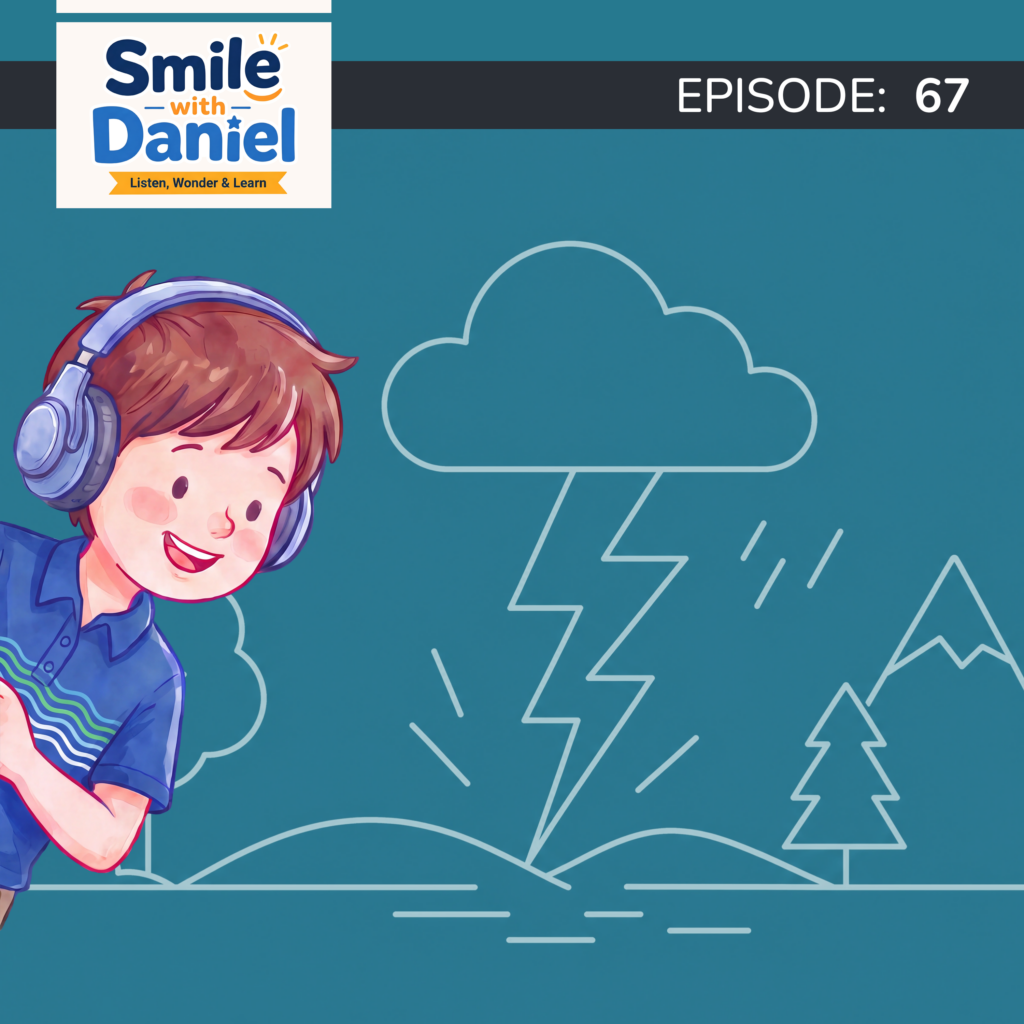
Lightning superheats the air in its channel to around 30,000 degrees Celsius, roughly five times hotter than the surface of the sun, in a fraction of a second. That air expands so fast it creates a shockwave, and that shockwave is thunder. The rumbling quality comes from the length of the lightning bolt itself. Shockwaves are generated at every point along the bolt, and because different parts of the bolt are at different distances from the listener, the sound arrives in a rolling sequence rather than a single bang. Close lightning cracks because those distances are tiny and the shockwaves arrive nearly simultaneously.
Daniel assumes thunder is the sound of clouds crashing together. The correction lands immediately and the conversation moves through the temperature of lightning, the shockwave mechanism, why close lightning sounds different from distant lightning, and the gap between flash and thunder as a way of measuring storm distance. The episode closes on a line that reframes every thunderstorm permanently.
Who’s talking
DanielHost & Chief Question-Asker
Daniel is nine. He asks the questions, refuses to accept easy answers, and picks every episode topic himself.
MomCo-host & Researcher
Mom does the digging - finding the sources, checking the claims, and translating them into something a nine-year-old will actually sit still for.
Things to remember
01
Thunder is a shockwave caused by lightning superheating air to around 30,000 degrees Celsius.
02
Lightning is roughly five times hotter than the surface of the sun in the channel where it strikes.
03
Thunder rumbles because shockwaves from different points along the bolt arrive at slightly different times.
04
Every three seconds between flash and thunder represents roughly one kilometer of distance to the storm.
“Every thunderstorm is the sound of the sky changing shape.”
DanielMom, where does thunder actually come from? Like, I know it has something to do with lightning, but what is the actual sound? Is it the clouds crashing together?
MomDaniel, it is not the clouds. The sound of thunder is actually the sound of air being ripped apart and snapping back.
DanielAir being ripped apart?
MomYes, by something five times hotter than the surface of the sun.
DanielWhat is five times hotter than the sun?
MomLightning. A lightning bolt heats the air in its channel to around 30,000 degrees Celsius in a fraction of a second. The surface of the sun is around 5,500 degrees. Lightning is five times hotter than that.
DanielLightning is five times hotter than the sun.
MomIn that narrow channel where it strikes. And when air is heated that fast and that intensely, it does not just expand. It explodes outward.
DanielLike, the heat blows the air away from it.
MomSo fast that it compresses the air in front of it into a shockwave. Scientists call it explosive expansion. And that shockwave traveling outward, that is the thunder you hear.
DanielSo thunder is not a sound the lightning makes. It is the sound of the air reacting to the lightning.
MomThe lightning is almost silent. The air around it is what screams.
DanielI did not expect that answer.
MomAnd now, the rumbling. If thunder is a shockwave, why does it rumble for so long? Instead of just one bang.
DanielYeah, sometimes it rolls for like 10 seconds.
MomBecause a lightning bolt is not a single point. It is a channel, sometimes miles long, zigzagging across the sky. A shockwave is generated at every single point along that channel.
DanielThere are thousands of shockwaves happening at once.
MomAnd they all travel different distances to reach your ears. The shockwave from the nearest part of the bolt arrives first. Then the ones from further along the channel as arrive a little later. And a little later. And a little later still.
DanielSo the rumble is all those shockwaves arriving one after another, not one single bang.
MomOne bolt, many points. Each one sending its own shockwave. To your ears at a slightly different time.
DanielAnd why does lightning, that is really close, sound like a crack instead of a rumble?
MomGood question. So, when lightning strikes very close, all those shockwaves arrive at nearly the same time. Because the distances between them are tiny, relative to where you are. So instead of a long rolling sequence, they arrive almost simultaneously as one sharp crack.
DanielSo close lightning cracks, and distant lightning rumbles. And it is the same shockwave, just arriving differently.
MomSame physics, different experience, depending on where you are standing.
DanielAnd why is it that we always see lightning before we hear thunder?
MomBecause light and sound travel at completely different speeds. Light travels at about 186,000 miles per second. Sound travels at about one-fifth of a mile per second at sea level.
DanielSo light is almost a million times faster than sound.
MomThey leave at exactly the same moment. But light reaches your eyes almost instantly. And sound takes its time traveling through the air to reach your ears.
DanielSo the gap between the flash and the thunder tells you how far away the lightning was.
MomEvery five seconds of gap is roughly one mile. Count the seconds between flash and thunder. Divide by five, and you know approximately how far away the storm is.
DanielSo the next time there is a storm, I can actually measure it with my ears.
MomYour ears and a little arithmetic. Which is exactly what thunderstorms have been teaching people for thousands of years. So Daniel, what is one thing you are taking with you today?
DanielI think I remember most of it, so thunder is not the clouds crashing. Lightning superheats the air so intensely and so fast that the air explodes outward, creating a shockwave. And that is the thunder. Also, the rumbling happens because the lightning bolt is long, and shockwaves from different points along the bolt arrive at different times.
DanielAnd the gap between flash and thunder tells you how far away the storm is.
MomFive seconds per mile. Next storm, start counting.
DanielI am going to be the most annoying person in the room during a thunderstorm.
MomThe most curious person in the room. There is a difference.