
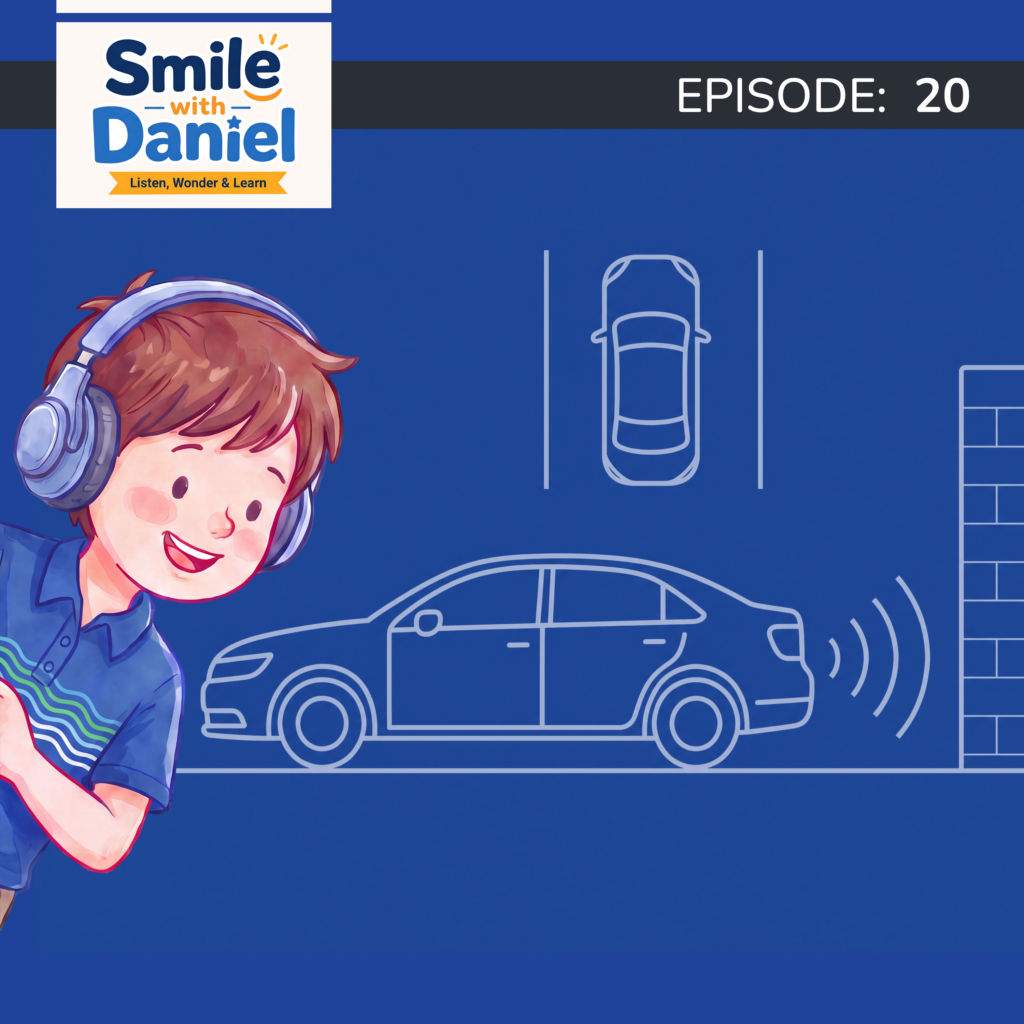

Parking sensors use ultrasonic echolocation, the same principle bats use to navigate in the dark. Sensors in the bumper emit ultrasonic pulses too high-pitched for humans to hear. When the pulse bounces off an object and returns, the system measures the time it took. Sound travels at a known speed, so the return time tells the computer how far away the object is. This calculation happens dozens of times per second. The beeping signal that warns a driver increases in frequency as the distance decreases, giving an intuitive sense of proximity without the driver needing to look at a display.
Daniel and Mom examine how ultrasonic echolocation works, why the timing calculation is too fast for a human to perform, and why the same physics that lets bats navigate a cave is now built into car bumpers everywhere.

Daniel is nine. He asks the questions, refuses to accept easy answers, and picks every episode topic himself.

Mom does the digging - finding the sources, checking the claims, and translating them into something a nine-year-old will actually sit still for.

Parking sensors emit ultrasonic pulses and measure how long they take to bounce back from obstacles.
Sound travels at a known speed, so return time tells the computer the distance to the object precisely.
The calculation happens dozens of times per second, faster than any human could manage manually.
The same echolocation principle bats use to navigate is built into the bumpers of modern cars.
“They have a bat in their bumper doing it for them.”