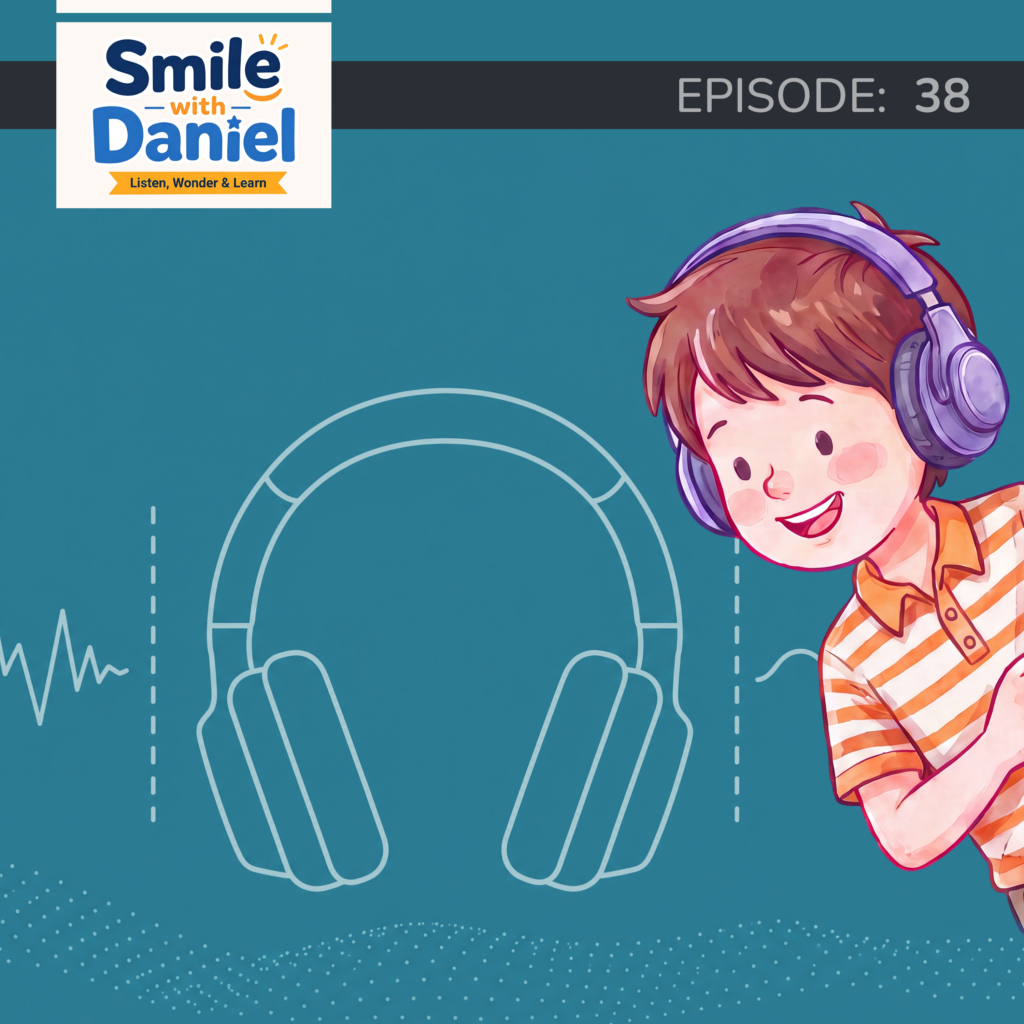
Active noise cancelling headphones use destructive interference to eliminate unwanted sound. A microphone on the exterior picks up ambient noise. Electronics generate a sound wave that is the phase-inverted mirror image of the incoming sound. When the two waves combine, they cancel each other. The result is silence created by adding sound rather than blocking it. The technique works most effectively on low-frequency, consistent sounds like engine noise and less effectively on sudden or high-frequency sounds whose wave patterns are harder to predict and invert in real time.
Daniel assumes noise cancelling headphones simply block sound more effectively than regular ones. The correction opens a conversation about what sound waves are, how waves combine through constructive and destructive interference, and how the electronics inside the headphones perform the inversion fast enough to cancel incoming sound in real time.
DanielMom, I put on my noise-canceling headphones on the plane last time, and it was like the engine just disappeared. How does that work? Are they just really thick padding that blocks the sound?
MomDaniel, that is what most people think. And guess what? They are wrong, in a really interesting way.
DanielReally? How are they wrong?
MomYou see, noise-canceling headphones do not block sound. They create more sound. And that new sound cancels the old sound out.
DanielThey fight sound with more sound? Are you just pulling my leg, Mom?
MomNo, I'm not. And I will tell you all about it. So, sound travels in waves, like ripples on water. Every sound has a shape, peaks and troughs, high points and low points, repeating over and over.
DanielOkay, sound waves. Got it.
MomNow, here is the key thing about waves. If you take two identical waves and line them up perfectly, peak matching peak, trough matching trough….
DanielThey get louder?
MomThey get louder. The waves add together. But, if you take that same wave and create an exact opposite version of it, peak matching trough, trough matching peak….
DanielThey cancel each other out.
MomExactly. The two waves meet, and the sound becomes much quieter. When the timing and amplitude line up very closely, they can come very close to canceling it out. That is called destructive interference.
DanielSo, noise-canceling headphones are creating an opposite wave of the outside sound, so the two cancel out.
MomThat is exactly what they do. There is a tiny microphone on the outside of each ear cup, constantly listening to whatever sound is coming in from the environment. A small processor analyzes that sound almost instantly, and generates an opposite version of that wave.
MomThen, that anti-sound wave is played through the speakers, at the same moment the original noise arrives at your ear.
DanielSo, by the time the engine noise gets to my ear, there is already an equal and opposite wave waiting for it, and they cancel out.
MomAnd all you hear is silence. Or your music.
DanielBut, it is not perfect, right? Like, voices still come through. Why does it work on the engine, but not as well on conversation?
MomThis is the clever bit. The system has to listen to the sound, analyze it, generate the opposite wave, and play it. All in a tiny fraction of a second. Low-frequency sounds, like engine rumble, air conditioning, traffic, repeat slowly and predictably. Easy to analyze.
MomEasy to cancel. And voices? Voices are much more complicated. Their pitch, loudness, and direction keep changing, and often several people are talking at once. That makes it much harder for the headphones to create a good opposite wave. The result is much less cancellation.
DanielSo, noise-canceling headphones are basically best at sounds that are steady and low, and less good at sounds that are fast and unpredictable.
MomWhich is exactly why they feel miraculous on a plane. That engine hum is perfect for them. And less magical in a noisy café where everyone is talking.
DanielAnd what about the padding? Does that do anything?
MomIt does. The physical seal of the earcup blocks some sound passively, just by being there. Most good headphones are doing two things at once. The padding is especially good at reducing many higher-frequency sounds. The electronics handle the low-frequency noise with active cancellation.
DanielSo there is a physical layer and an electronic layer working at the same time.
MomAnd they are designed to complement each other. The electronics do not have to do all the work, because the padding already took care of some of it.
DanielSo when I put on those headphones on the plane, a tiny microphone was listening to the engine, a processor was generating the opposite wave, and the speakers were playing it back, all timed so both waves reach my ear at the same moment.
MomThousands of times every second, without you noticing any of it.
DanielThat is kind of incredible. Something I just put on my head was doing all of that the whole flight.
MomAnd it needs a battery to do all of that. Creating the opposite sound takes microphones, electronics, and speakers running continuously. Turn the battery off, the processor stops, the anti-sound stops, and the active cancellation disappears. The padding still does its job, but the electronic layer is gone.
DanielThat explains why my headphones feel different when the battery dies.
MomNow you know exactly why. And here is one more thing. The idea of canceling sound with more sound was first patented in the 1930s. But tiny computers fast enough to make it practical in a pair of headphones didn't arrive until many decades later.
DanielSo someone had the right idea almost a hundred years ago, and just had to wait for the technology to catch up.
MomSometimes the best ideas arrive before the tools to build them. So, Daniel, what is one thing you are taking with you today?
DanielOkay, so noise-canceling headphones do not block sound. They create an opposite sound wave that cancels the incoming noise out. I believe a microphone listens to the outside sound, a processor generates the exact opposite wave, and that anti-wave is played back so the two cancel each other.
DanielYou told me that it works best on low, steady sounds, like engine hum, because those are easy to analyze and cancel. Also, voices and unpredictable sounds are harder because they are much more complicated. Their pitch, loudness, and direction keep changing, so it is much harder for the headphones to create the right opposite wave.
DanielAnd the padding does something too. It blocks some higher frequency noise physically, so both layers work together.
MomYou got it! You fight sound with more sound.
DanielI am never going to put on headphones the same way again.