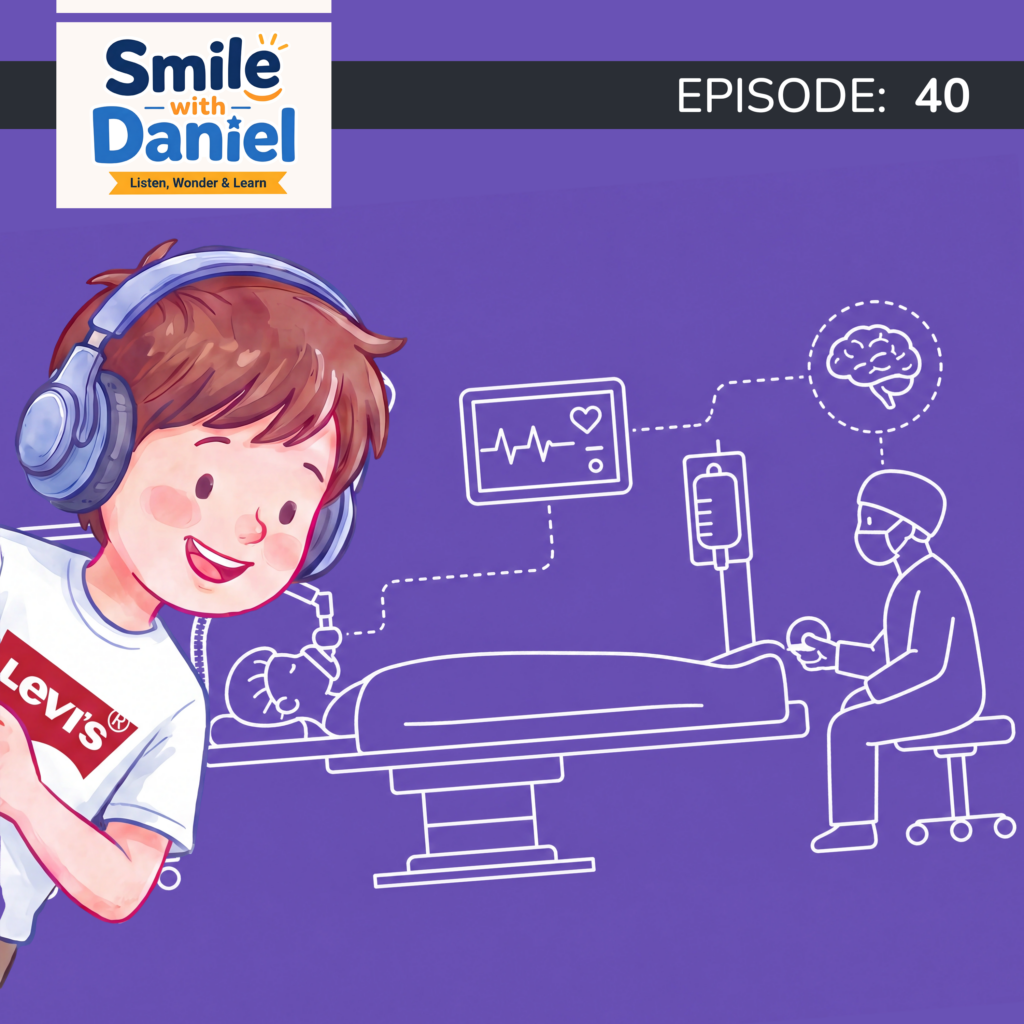
General anesthesia has been used in surgery since the 1840s and is one of the most important tools in medicine. It reliably produces unconsciousness and prevents the experience of pain. Yet scientists do not have a complete explanation for exactly how it works. Leading theories involve anesthetic agents disrupting organized communication between distant parts of the brain, which appears to be connected to losing conscious awareness. The challenge is that consciousness itself is not fully understood, making a complete mechanistic explanation of anesthesia difficult to establish.
Daniel and Mom examine what anesthesia does, what the leading theories propose, why the mechanism is so hard to pin down, and what the uncertainty reveals about the limits of current scientific understanding. The episode treats the honest uncertainty as the most interesting part of the story rather than a gap to be papered over. The closing lines land on what makes anesthesia one of the most philosophically interesting tools in all of medicine.
DanielMom, my friend had surgery last week, and he said one second the doctor was counting down, and the next second he was waking up, and it felt like no time had passed at all. What actually happened in between?
MomDaniel, that feeling of no time passing is one of the most remarkable things about general anesthesia. And what happened in between is genuinely fascinating.
DanielWas he just asleep?
MomThat is the first thing most people get wrong. General anesthesia is not ordinary sleep. Sleep is a natural, reversible brain state. Anesthesia is a drug-controlled state designed to make you unaware, prevent memory, control pain, and keep you still enough for surgery.
DanielInteresting. So what is it then?
MomIt is a medically controlled state designed to make you unconscious, unaware of the operation, and unable to remember it afterward. For most people, the experience feels like an instant jump from before the surgery to after it.
DanielSo even if hours passed, there is no memory connecting the two moments?
MomExactly. Researchers think some people may still have dreamlike internal experiences during anesthesia, but usually none of it becomes part of the story they remember afterward.
DanielHow do the drugs actually do that? How do they switch off consciousness?
MomSo anesthesia is not one drug doing one thing. It is often several medicines working together. One may keep you unconscious and prevent memories, others control pain, and sometimes another relaxes muscles when the operation requires it. The exact combination depends on the patient and the surgery.
DanielAnd I'm assuming that someone is managing all of that at once?
MomYes, the anesthesiologist. Their entire job during the surgery is to monitor you constantly, your breathing, oxygen level, heart rate, blood pressure, and, when useful, electrical patterns from the brain. Their focus throughout the operation is your anesthesia, breathing, circulation, and safety.
MomIt is one of the most demanding jobs in medicine.
DanielSo while the surgeon is focused on the surgery, someone else is entirely focused on keeping you in that exact state?
MomAnd bringing you back out of it safely at the end. The waking up is just as carefully managed as the going under.
DanielOkay, but how does the drug actually stop consciousness? Like, what is it doing in the brain?
MomThis is where it gets genuinely interesting. The drugs interfere with how different parts of the brain communicate with each other. One way to think about it, your brain normally has constant back-and-forth conversation happening between different regions, the front and the back, the sensory areas and the thinking areas.
DanielAnd anesthesia interrupts that conversation?
MomMany anesthetics disrupt the organized communication that normally links distant brain regions. Sensory areas may still respond, but the brain becomes much less able to integrate those signals into awareness of the outside world. Scientists think that breakdown is an important part of unconsciousness, but probably not the entire explanation.
DanielSo consciousness may depend partly on distant parts of the brain sharing and combining information. And anesthesia disrupts that.
MomDaniel, that is a genuinely sophisticated way to put it. And it is very close to what neuroscientists currently believe.
DanielCurrently believe? They are not sure?
MomThis is the part that I find most remarkable. General anesthesia entered public surgical practice in 1846. The first public demonstration was at Massachusetts General Hospital. A dentist named William Morton administered ether while a surgeon removed a tumor from a patient's neck.
MomThe patient showed no sign of feeling the operation's pain. It was considered a miracle.
Daniel1846? That is almost 200 years ago!
MomNearly 200 years later, modern anesthesia has become remarkably safe and precise. And yet, scientists still do not fully understand the exact mechanism by which these drugs switch off consciousness. We understand many of the receptors the drugs affect, how they change brain activity, and how to use them safely.
MomWhat scientists still debate is exactly how all those changes produce the loss, and return, of conscious awareness. But the deeper question...
DanielWhy does stopping that conversation turn off the experience of being alive?
MomThat is still one of medicine's open questions. And the reason it is so hard to answer is that it is connected to one of the deepest mysteries in all of science. What consciousness actually is?
DanielSo people have been using general anesthesia for nearly 200 years, and we still do not completely know why it works.
MomWe understand a great deal about how. The why, at the deepest level, is still being studied. And some of the most important research into consciousness itself now comes from studying what anesthesia does to the brain.
DanielSo anesthesia is not just useful for surgery. It is also a tool for understanding consciousness.
MomExactly! By studying consenting volunteers with tools like EEG and brain imaging, researchers can observe how responsiveness and patterns of brain activity change as people enter and emerge from anesthesia. That makes anesthesia one of science's most useful windows into consciousness.
DanielThat is kind of beautiful. Something that started as a way to stop pain during surgery is now helping us understand what it means to be conscious. Should people be scared of it?
MomModern general anesthesia is very safe for most people, especially during planned surgery. Temporary effects like nausea or drowsiness afterward are fairly common. Serious complications are rare. The exact picture depends on the person's health and the operation, which is why the anesthesia team plans and monitors everything so carefully.
DanielAnd someone was watching over you the entire time in between.
MomThe entire time. Your anesthesia, your breathing, your circulation. That is their complete focus throughout. So Daniel, what is one thing you are taking with you today?
DanielOkay, so general anesthesia is not ordinary sleep. It is a carefully controlled state designed to make you unconscious, unaware of the operation, and unable to remember it afterward. Anesthesia often uses several medicines. Some keep you unconscious and prevent memories.
DanielOthers control pain, and muscle relaxants are sometimes used when the surgery requires them. An anesthesiologist monitors your breathing, oxygen, circulation, and safety the entire time. Many anesthetics disrupt the organized communication between distant parts of the brain, which seems to be an important part of losing awareness, although scientists still do not think that is the whole explanation.
DanielAnd here is the part that got me. Surgical anesthesia began publicly in 1846, and modern anesthesia has become remarkably safe and precise. But scientists are still studying exactly how those changes in the brain cause conscious awareness to disappear and return.
DanielBecause that question is connected to what consciousness actually is.
MomOne of the oldest tools in medicine, still teaching us something new.
DanielI am going to think about this the next time I am at the dentist.
MomYou will probably be fine with just the numbing gel.