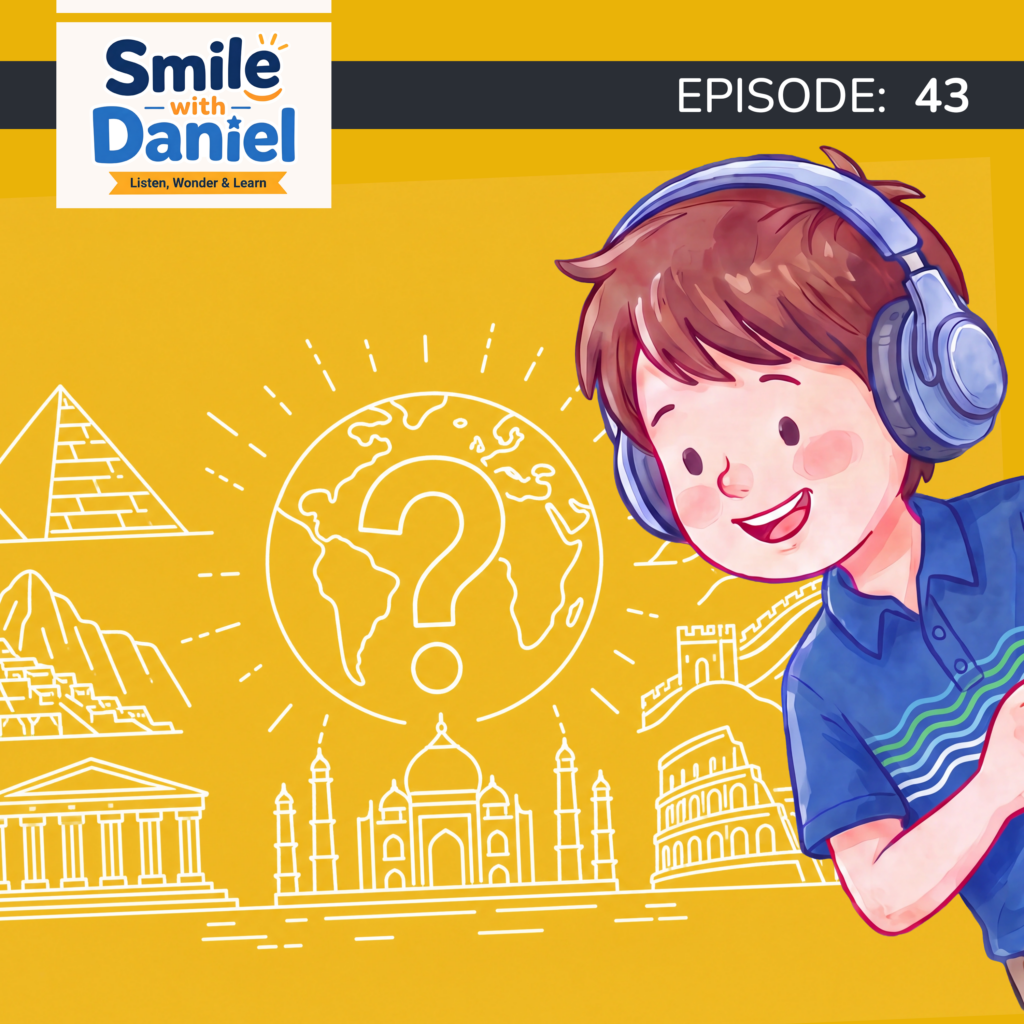
The Seven Wonders of the Ancient World were not voted on or officially designated. They were compiled by ancient Greek and Roman writers describing the most impressive structures within their known world, the Mediterranean and Near East. The list most commonly cited today is associated with Antipater of Sidon, writing around 140 BC, though the compilation evolved over several centuries. Of the seven, only the Great Pyramid of Giza survives. The others were destroyed by earthquake, fire, looting, and time, the last of them, the Lighthouse of Alexandria, probably falling in the fourteenth century.
Daniel and Mom examine who made the list, what each wonder was and what became of it, what the selection reveals about the limits of the ancient Mediterranean worldview, and why only one wonder still stands. The episode closes on the Great Pyramid’s extraordinary survival.
DanielMom, what are the seven wonders of the world? Like, who decided what they are? Is there some kind of official committee?
MomDaniel, that is a much more interesting question than it sounds. Because there isn't one official list. There are many, but the two that people usually mean are the ancient seven wonders and a modern list announced in 2007.
DanielWhat? There are two lists?
MomYes, the ancient list and the modern one. And they were created about 2,000 years apart by completely different people for completely different reasons.
DanielIt sounds very interesting.
MomFirst, let's start with the ancient wonders. More than 2,000 years ago, Greek writers around the Mediterranean began making lists of extraordinary sites, almost like ancient travel recommendations.
DanielLike a travel guide?
MomExactly like that. Several writers made their own versions. Antipater of Sidon described wonders in a poem. A work connected with Philo of Byzantium listed seven remarkable sites around 225 BC. Their lists were not identical. Over the centuries, one combination became the standard we recognize today.
DanielWhy seven?
MomSeven was considered a meaningful and complete number in the ancient world. And perhaps it also made a memorable list, although nobody left us an official explanation.
DanielWhat did the list include, Mom?
MomThe Great Pyramid of Giza in Egypt. The Hanging Gardens of Babylon. The Temple of Artemis in what is now Turkey. The Statue of Zeus at Olympia. The Mausoleum at Helicarnassus. The Colossus of Rhodes, an enormous bronze statue that towered over ancient roads. And the Lighthouse of Alexandria.
DanielWow, those sound incredible. Are any of them still standing?
MomOnly one still stands substantially intact. The Great Pyramid of Giza. The others collapsed or were destroyed over the centuries by earthquakes, fires, warfare, and time. Archaeologists have found remains of several, but none still looks as it did in the ancient world.
DanielSo most of the seven wonders of the ancient world don't exist anymore.
MomAnd one of them, the Hanging Gardens of Babylon, is deeply mysterious. No convincing remains have been found at Babylon, and contemporary Babylonian records don't clearly mention them. Some historians think they were legendary. Others think the stories may actually describe gardens that existed somewhere else entirely, perhaps at Nineveh.
DanielSo one of the most famous wonders may have been in the wrong city, or may not have existed at all?
MomI love how you are following me now. These were lists made by writers based on what they had heard, read, or perhaps seen. Not a scientific survey, not a committee of experts, just people sharing what impressed them. And because the lists came from Greek and Mediterranean writers, they reflected the part of the world those writers knew.
MomThey left out monuments in India and China, achievements in the Americas, and countless extraordinary structures beyond their cultural horizon.
DanielSo it was really seven wonders from the part of the world those Mediterranean writers knew and traveled through.
MomExactly. A remarkable list, but not a global survey.
DanielSo what about the modern list? Who made that one?
MomA Swiss filmmaker named Bernard Weber. Around year 2000, he set up a private foundation and launched a global vote. Anyone could go online or vote by phone. By the time results were announced, the organizers said more than 100 million votes had been cast online and by telephone.
DanielSo this time, the modern seven wonders were chosen by public vote?
MomYes, by public vote. And the winners announced in 2007 were... The Great Wall of China, Petra in Jordan, the Roman Coliseum, Chichen Itza in Mexico, Machu Picchu in Peru, the Taj Mahal in India, and Christ the Redeemer in Brazil.
DanielThose are places I've actually heard of. They're famous.
MomBut the method was criticized. Countries could campaign heavily for their candidates, people did not have equal access to phones or the internet, and the total counted votes, not necessarily one vote from each individual person.
DanielDid any official organization endorse it?
MomUNESCO, the United Nations' cultural organization, formally distanced itself from the whole campaign. They said they had no link to it, and that their own World Heritage Program is based on scientific and educational criteria, not a popularity vote.
DanielSo the most famous list of modern wonders, the UN, basically said wasn't theirs.
MomNot UNESCO's, and not an official United Nations' list. It was an enormously popular private campaign, but still a private campaign.
DanielWhat happened to the Great Pyramid? It's the only ancient wonder still standing. Was it on the modern list?
MomThe organizers gave it honorary status, outside the vote entirely. They said it was already so significant that it shouldn't have to compete, which some people found reasonable, and others found a little convenient.
DanielSo the only ancient wonder still standing was honored by the modern campaign, but kept outside its list of seven winners.
MomIt did, about four and a half thousand years old, and still getting special treatment. So Daniel, what is one thing you are taking with you today?
DanielOk, so, the ancient list gradually developed from different Greek and Mediterranean writers, more than two thousand years ago. Their versions did not always agree, and they reflected the part of the world those writers knew. Only the Great Pyramid still stands substantially intact, and the Hanging Gardens may have been somewhere else, or may never have existed as described.
DanielThe modern list came from a private worldwide vote announced in 2007, not from UNESCO, and the voting process was criticized because publicity and access to technology were not equal.
MomAnd the Great Pyramid was on the ancient list, and received honorary status from the modern campaign, without having to enter the vote.
DanielAbout four and a half thousand years old, and still plays by its own rules.