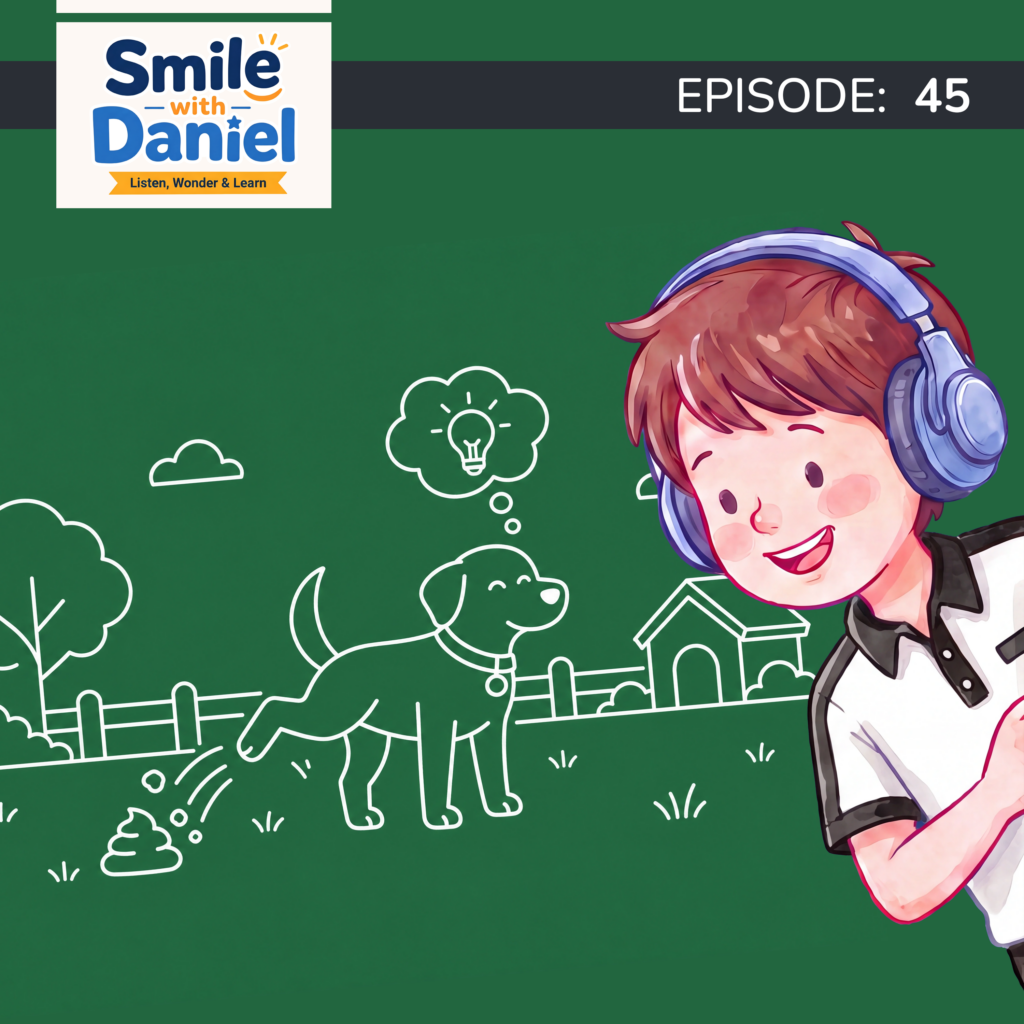
Dogs kick the ground after going to the bathroom not to cover up waste but to spread scent signals from glands in their paws. Those glands release pheromones when the dog scratches, extending the scent mark over a wider area and making it more durable than the waste deposit alone. The behavior appears to be communicative rather than hygienic, functioning as a territorial and social signal to other dogs in the area. Wild canids including wolves show the same behavior.
Daniel and Mom examine what the kicking is actually doing, how paw scent glands work, why spreading the signal matters more than burying the source, and what the behavior reveals about dog communication more broadly. The episode closes on Daniel realizing his dog has been leaving messages on every walk.
Daniel is nine. He asks the questions, refuses to accept easy answers, and picks every episode topic himself.
MomCo-host & Researcher
Mom does the digging - finding the sources, checking the claims, and translating them into something a nine-year-old will actually sit still for.
Things to remember
01
Dogs kick after going to the bathroom to spread pheromones from scent glands in their paws, not to cover waste.
02
The kicking extends the scent mark over a wider area, making the signal more visible to other dogs.
03
The behavior is communicative, functioning as a territorial and social signal rather than a cleanup instinct.
04
Wild canids including wolves show the same behavior, suggesting it is deeply rooted in canid communication.
“So the kick is not covering anything up. It is the opposite. She is spreading more scent using scent glands in her paws to amplify her territorial message.”
DanielMom, she's covering it up, you know, like cats do in a litter box.
MomGood guess. That is what almost everyone thinks. But it is the opposite of what is actually happening.
DanielThe opposite?
MomShe is not hiding the poop. She is actually making it louder.
DanielMaking it louder? How and why do you make poop louder?
MomDogs have scent glands in their paws, between the pads. When she kicks the ground, those glands release pheromones, which are chemical signals.
DanielSo she is leaving a smell from her paws as well.
MomExactly. So now there are two scent signals, the poop itself and the chemical signals from her paws. Together, they spread her message over a wider area.
DanielSo instead of covering the smell up, she is adding to it, making it bigger and stronger.
MomShe is amplifying her message. The scratches in the ground are a visual signal too. Other dogs can see the marks and know something was there. Scent plus scratches. Two channels at once.
DanielSo it is like a dog leaving a really thorough message. Poop says, I was here. Paw scent says, I was here and I am still in the area. And scratch marks say, look, something happened here.
MomYou have got the idea exactly.
DanielWhere does this come from? Did dogs invent this?
MomIt actually comes from wolves, you know. This goes all the way back to dogs' wild ancestors. You see, for wild wolves, territory is extremely important. It determines where a pack can hunt, where they can sleep, where they can raise pups. Scent marking is how a pack announces their boundaries without having to be physically present.
DanielSo the dog is doing a wolf thing.
MomYes, a very old wolf thing. And even though our dog lives in a house and gets fed every day, that instinct is still deeply wired in. She sees another dog's scent and the response kicks in automatically.
DanielIs that why she does it more enthusiastically when other dogs have been in the backyard?
MomExactly that. The more competition she senses, other dogs nearby, fresh scent from strangers, the more urgently she wants to overmark. It is like someone writing their name somewhere, and then you write your name right over it, bigger.
DanielSo it is a dog turf war happening in our backyard.
MomEvery single time. And here is something that might connect a dot you have noticed. Have you ever smelled a dog's paws?
DanielThey smell like corn chips.
MomFrito feet. That corn chip smell mostly comes from harmless bacteria and yeast that live on the paw pads. But those same paws also contain scent glands that release chemical signals when she kicks the ground. So the paws are doing two related things at once, and you have been noticing one of them all along.
DanielI have sniffed my dog's territorial scent glands and called them corn chips.
MomMany times, probably.
DanielDoes every dog do this?
MomNot every dog. Some do it almost every time, others only occasionally, and some hardly ever. Some individual dogs seem much more likely to do it than others, but it is seen in both male and female dogs equally. It is not just a male thing, you know.
DanielSo some dogs just have stronger territorial instincts than others.
MomAnd even in the same dog, it varies. Near a busy path where lots of dogs walk, she kicks every time. In a quiet spot with no other dog scent, sometimes she just walks away.
DanielSo the kick is not random, it is a response to what she senses. More competition, more kicking.
MomShe is reading the environment and responding. She is not planning it the way we plan things. It is an instinctive behavior. But it works. So, Daniel, what is one thing you are taking with you today?
DanielOkay, so the kick is not covering anything up. It is the opposite. She is spreading more scent using scent glands in her paws to amplify her territorial message. It comes from wolves, marking territory so other animals know the area is claimed. And the paws that smell like corn chips also have scent glands that help spread her message.
MomShe is not being weird. She is being a wolf.
DanielI am never going to look at her the same way after she poops.