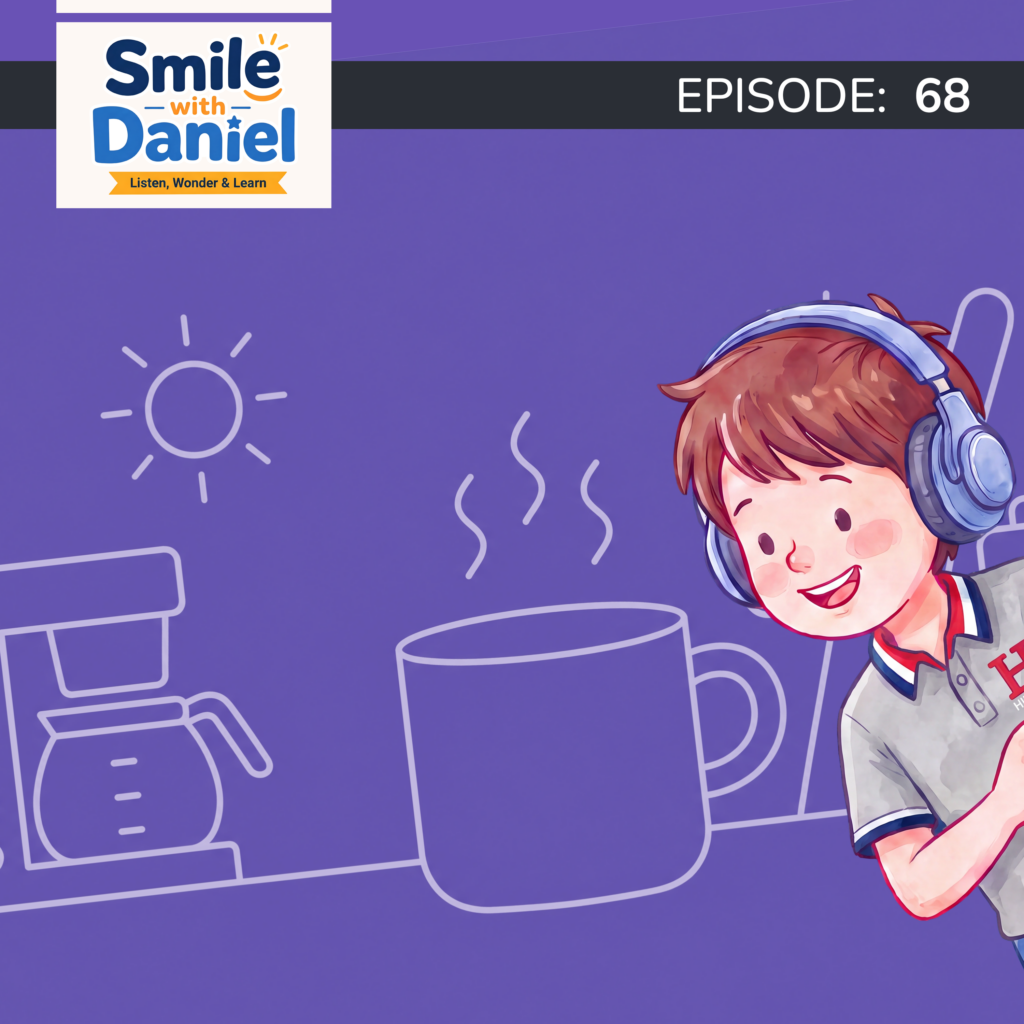
As the brain works throughout the day, a chemical called adenosine builds up and attaches to receptors that signal tiredness. Caffeine’s molecular structure is similar enough to adenosine that it can occupy the same receptors without activating them, effectively pressing mute on the tired signal. The adenosine keeps building while caffeine is in the system. When the caffeine wears off, that accumulated adenosine floods back all at once, which is the crash. Only sleep can actually clear adenosine. Caffeine can delay the signal but cannot erase it.
Daniel assumes coffee gives Mom energy. The correction opens a conversation about adenosine, the receptor-blocking mechanism, and what the crash actually is. The episode frames caffeine as borrowing time rather than creating energy, and the exchange lands on a closing line that reframes every morning cup. The episode is framed carefully around adult coffee consumption, with Daniel observing Mom rather than discussing his own.
MomDaniel, you have seen me drink coffee in the morning. What do you think it actually does for me?
DanielMom, does it give you energy? That is why everyone drinks it, no?
MomThat is what most people think. But coffee does not actually give you energy. Not exactly. It doesn't? It does something much more interesting. It stops your brain from knowing that it is tired.
DanielHow does it do that?
MomSo, all day long, as your brain works and thinks, it produces a chemical called adenosine. A-den-sine.
DanielAdenosine. What does it do exactly?
MomIt builds up gradually throughout the day. And as it builds, it attaches to special receptors in your brain, almost like keys fitting into locks. And when those receptors are filled with adenosine, your brain gets a message. You are tired. Time to rest.
DanielSo, adenosine is basically your brain's tiredness signal.
MomA tiredness signal that builds all day and gets cleared when you sleep. That is why you feel fresh in the morning and tired by the evening.
DanielSo where does the coffee come in then?
MomCaffeine, the active ingredient in coffee, has a molecular shape that is remarkably similar to adenosine. Similar enough that it can slip into the same receptors, the same locks, and take up the space where adenosine would sit.
DanielSo caffeine fits into the same locks as adenosine.
MomBut here is the important difference. Caffeine fits in, but does not activate the receptor. It just blocks the seat. So adenosine cannot sit down. And if adenosine cannot sit down, it cannot send the tired message.
DanielSo your brain still has all the adenosine, it just cannot feel it.
MomExactly. The tiredness is still there, accumulating in the background. Caffeine just presses the mute button on the signal.
DanielSo coffee doesn't give you energy. It just stops you from noticing that you are tired.
MomThe energy was yours all along. You just could not feel it. Because adenosine was telling you to rest.
DanielThat is completely different from what I thought was happening.
MomAnd here is what happens when the caffeine wears off. All that adenosine that has been building up, waiting in the background, suddenly floods back into the receptors all at once.
DanielOh, so that is the crash.
MomThat is exactly the crash. Not the coffee running out, but all the tiredness you were not allowed to feel, arriving all at once.
DanielSo the crash is not the coffee leaving. It is the tiredness coming back with interest.
MomWith everything it had stored up, while caffeine was blocking it.
DanielAnd can coffee replace sleep? So if you have enough coffee, do you not need to sleep?
MomNo, because caffeine can only block the tired signal. It cannot clear the adenosine itself. Only sleep does that. Sleep is the brain's way of clearing away the adenosine that built up during the day.
DanielSo no matter how much coffee you drink, the adenosine is still building. You just cannot feel it piling up.
MomAnd when you finally do sleep, your brain has a lot of catching up to do.
DanielSo coffee is less like getting energy, and more like borrowing time that you will have to pay back later.
MomThat is one of the most accurate descriptions of caffeine I have ever heard. So Daniel, what is one thing you are taking with you today?
DanielLet me drink some of your coffee first, to help me remember. Just kidding. Let's see. Coffee does not give you energy. It blocks a chemical called adenosine, which is your brain's tiredness signal, from attaching to its receptors. The tiredness is still building in the background.
DanielCaffeine just stops your brain from feeling it. When caffeine wears off, all that built up adenosine floods back at once, which is the crash. And only sleep can actually clear the adenosine, not caffeine.
MomThe energy was always yours. Coffee just lets you borrow against tomorrow.
DanielI'm going to think about that every time I see you drinking coffee in the morning.
MomCoffee lets you borrow time. And sleep is how you pay it back.